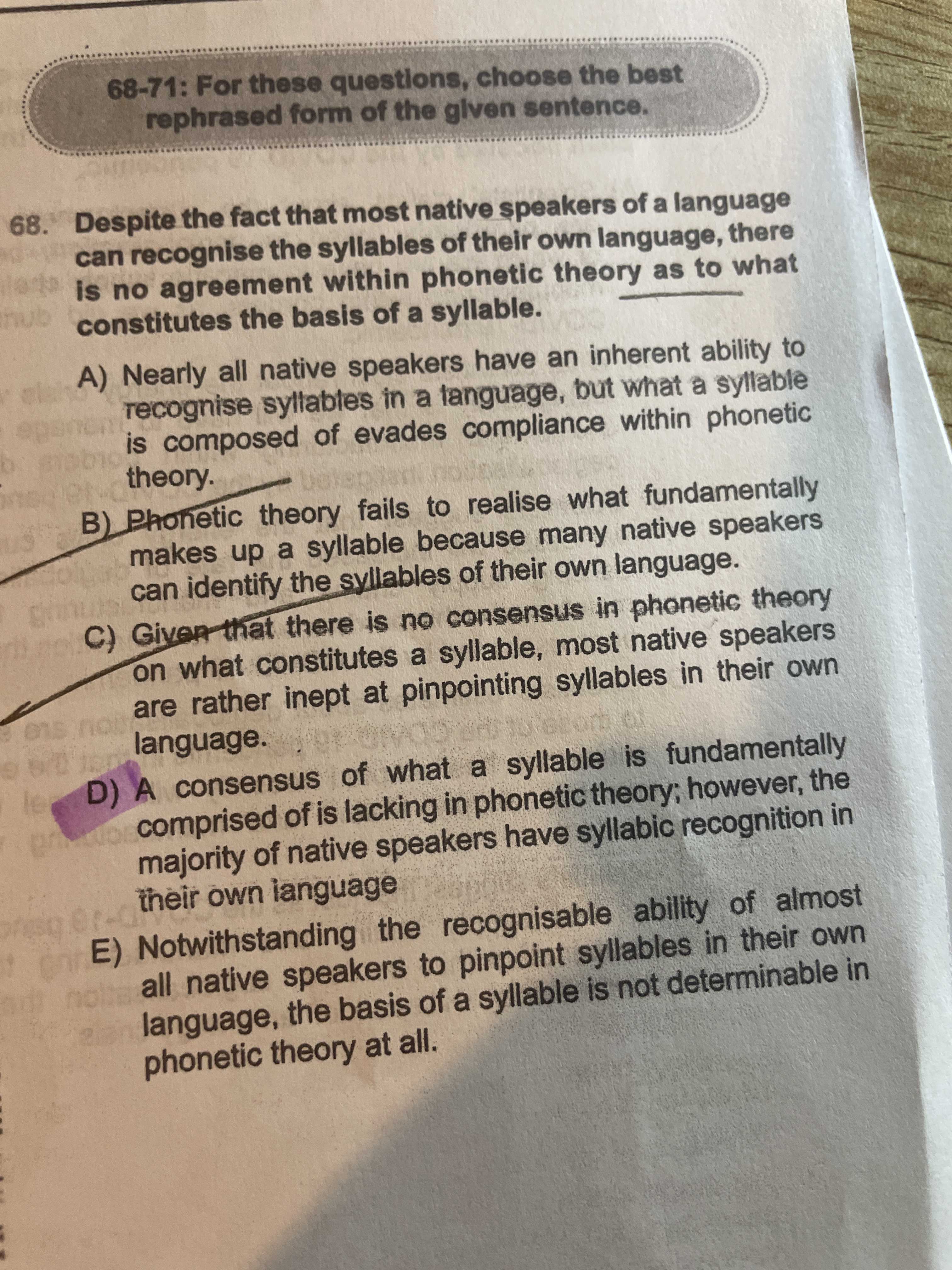
Despite the fact that most native speakers of a language can recognise the syllables of their own language, there is no agreement within phonetic theory as to what constitutes the basis of a syllable.
A) Nearly all native speakers have an inherent ability to recognise syllables in a language, but what a syllable is composed of evades compliance within phonetic theory.
B) Phonetic theory fails to realise what fundamentally makes up a syllable because many native speakers can identify the syllables of their own language.
C) Given that there is no consensus in phonetic theory on what constitutes a syllable, most native speakers are rather inept at pinpointing syllables in their own language.
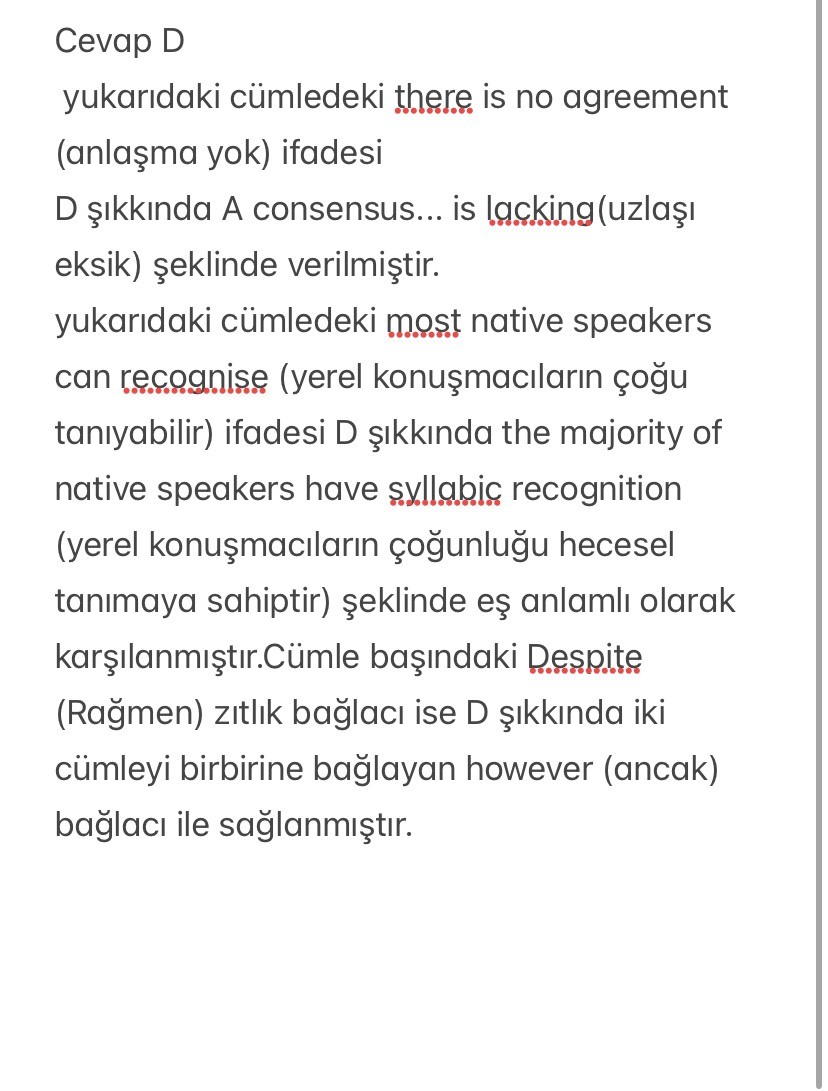
D) A consensus of what a syllable is fundamentally comprised of is lacking in phonetic theory; however, the majority of native speakers have syllabic recognition in their own language
E) Notwithstanding the recognisable ability of almost all native speakers to pinpoint syllables in their own language, the basis of a syllable is not determinable in phonetic theory at all.