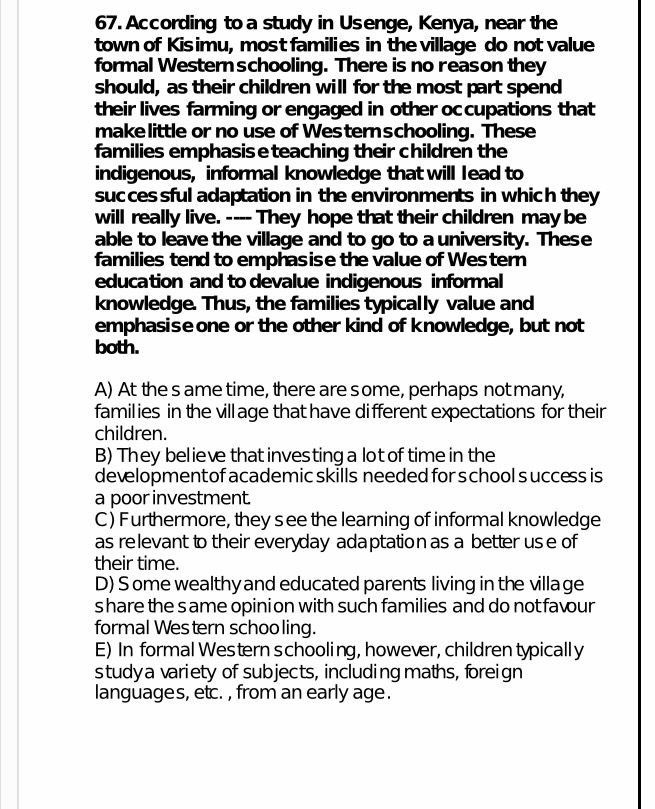
According to a study in Usenge, Kenya, near the town of Kisimu, most families in the village do not value formal Western schooling. There is no reason they should, as their children will for the most part spend their lives farming or engaged in other occupations that make little or no use of Western schooling. These families emphasise teaching their children the indigenous, informal knowledge that will lead to successful adaptation in the environments in which they will really live. -— They hope that their children may be able to leave the village and to go to a university. These families tend to emphasise the value of Western education and to devalue indigenous informal knowledge. Thus, the families typically value and emphasise one or the other kind of knowledge, but not both.
A) At the same time, there are some, perhaps not many, families in the village that have different expectations for their children.
B) They believe that investing a lot of time in the development of academic skills needed for school success is a poor investment.
C) Furthermore, they see the learning of informal knowledge as relevant to their everyday adaptation as a better use of their time.
D) Some wealthy and educated parents living in the village share the same opinion with such families and do not favour formal Western schooling.
E) In formal Western schooling, however, children typically study a variety of subjects, including maths, foreign languages, etc., from an early age.